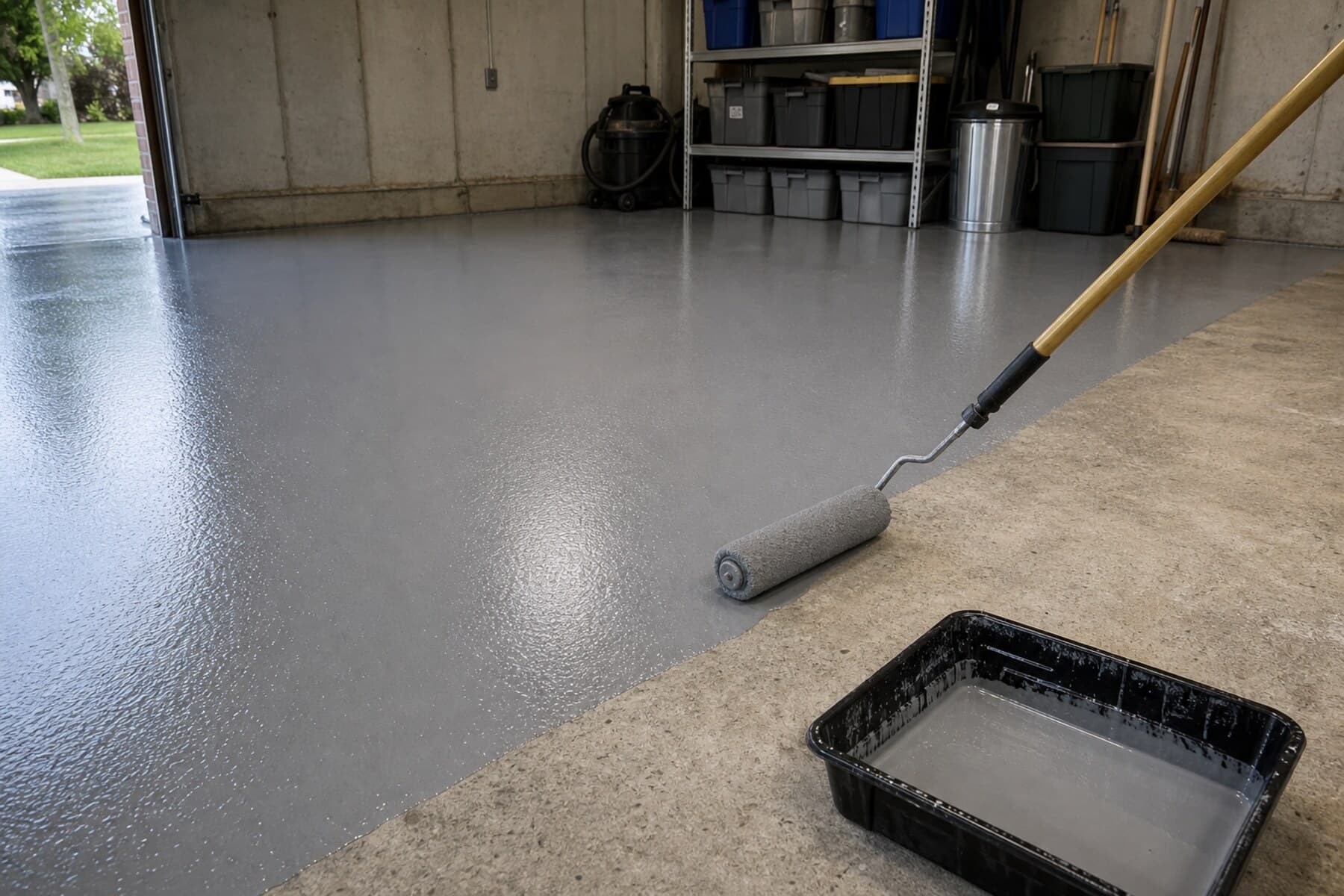
What Is an Epoxy Garage Floor?
An epoxy garage floor is a resin coating system applied over prepared concrete. It can create a cleaner, harder-wearing surface than bare concrete when the slab is ground, cleaned, repaired, and coated correctly.
Many Iowa City homeowners use the word epoxy for any coated garage floor. In real quotes, you may see epoxy, polyurea, polyaspartic, or a combination of products depending on the floor and the desired return-to-use time.
| Factor | Epoxy | Polyaspartic |
|---|---|---|
| Cure time | Often slower, especially in cool weather | Often faster return-to-use |
| UV stability | Can amber in direct UV without the right topcoat | Usually stronger UV stability |
| Cost | Often lower material cost | Often higher material cost |
| Durability | Good when installed over properly prepared concrete | Strong chemical and abrasion resistance |
| Install window | More temperature sensitive | Works across a wider install window |
| Best use case | Budget-aware garages and interior concrete | Fast-turnaround full-flake garage systems |
- • Ask how the concrete will be prepared
- • Confirm whether cracks and pits are included
- • Compare full-flake and partial-flake finishes
- • Understand cure time before parking
Why Homeowners Search for Epoxy Floors
People search for epoxy garage floors because bare concrete gets dusty, stained, and harder to clean over time. Epoxy is also the term many homeowners already know from big-box kits and contractor ads.
The important question is not only whether a floor is epoxy. Ask how the concrete will be prepared, how cracks will be repaired, and what topcoat will protect the finished floor.
| Factor | Epoxy | Polyaspartic |
|---|---|---|
| Cure time | Often slower, especially in cool weather | Often faster return-to-use |
| UV stability | Can amber in direct UV without the right topcoat | Usually stronger UV stability |
| Cost | Often lower material cost | Often higher material cost |
| Durability | Good when installed over properly prepared concrete | Strong chemical and abrasion resistance |
| Install window | More temperature sensitive | Works across a wider install window |
| Best use case | Budget-aware garages and interior concrete | Fast-turnaround full-flake garage systems |
Epoxy vs Modern Flake Coating Systems
A modern flake system may use epoxy as a base coat, or it may use polyurea or polyaspartic materials. The decorative flakes are broadcast into the wet coating, then sealed under a clear topcoat.
For daily-use garages, the finished system matters more than the name alone. Full-flake coverage, texture, topcoat quality, and concrete prep all affect how the floor looks and cleans up.
| Factor | Epoxy | Polyaspartic |
|---|---|---|
| Cure time | Often slower, especially in cool weather | Often faster return-to-use |
| UV stability | Can amber in direct UV without the right topcoat | Usually stronger UV stability |
| Cost | Often lower material cost | Often higher material cost |
| Durability | Good when installed over properly prepared concrete | Strong chemical and abrasion resistance |
| Install window | More temperature sensitive | Works across a wider install window |
| Best use case | Budget-aware garages and interior concrete | Fast-turnaround full-flake garage systems |
- • Ask how the concrete will be prepared
- • Confirm whether cracks and pits are included
- • Compare full-flake and partial-flake finishes
- • Understand cure time before parking
Prep and Crack Repair
Epoxy needs a clean, profiled surface to bond. Professional prep usually means diamond grinding, edge work, vacuuming, and removing weak surface material before coating.
Cracks and pitted spots should be repaired before the base coat. Filled cracks may still be visible in some cases, but proper repair helps the coating look better and last longer.
Cost Factors
Epoxy garage floor cost in Iowa City depends on garage size, concrete condition, repairs, coating thickness, flake coverage, topcoat, and whether old paint or sealer must be removed.
A useful quote should explain the full scope, not just a square-foot price. That makes it easier to compare epoxy flooring quotes fairly.
- • Ask how the concrete will be prepared
- • Confirm whether cracks and pits are included
- • Compare full-flake and partial-flake finishes
- • Understand cure time before parking
Is Epoxy Right for Your Garage?
Epoxy can be a good fit for many garages, especially when budget matters and the installer has enough time for proper cure. It may not be the fastest option when quick return-to-use is the top priority.
If you want a full-flake floor with fast cure and strong UV stability, ask about polyaspartic options too. A good installer should explain the tradeoffs without pushing one product name.
| Factor | Epoxy | Polyaspartic |
|---|---|---|
| Cure time | Often slower, especially in cool weather | Often faster return-to-use |
| UV stability | Can amber in direct UV without the right topcoat | Usually stronger UV stability |
| Cost | Often lower material cost | Often higher material cost |
| Durability | Good when installed over properly prepared concrete | Strong chemical and abrasion resistance |
| Install window | More temperature sensitive | Works across a wider install window |
| Best use case | Budget-aware garages and interior concrete | Fast-turnaround full-flake garage systems |
Need a quote for your actual floor?
Concrete condition changes the best coating plan. Share the size, city, cracks, stains, and old coating details before comparing options.